Buying Guides
Cosmetic Labels for the US Market: What to Print So Your Products Pass FDA and Retail Checks
The eight items a US cosmetic label should carry, where each goes, and which are law (Made in China) versus retail or buyer requirements (barcode, dates).
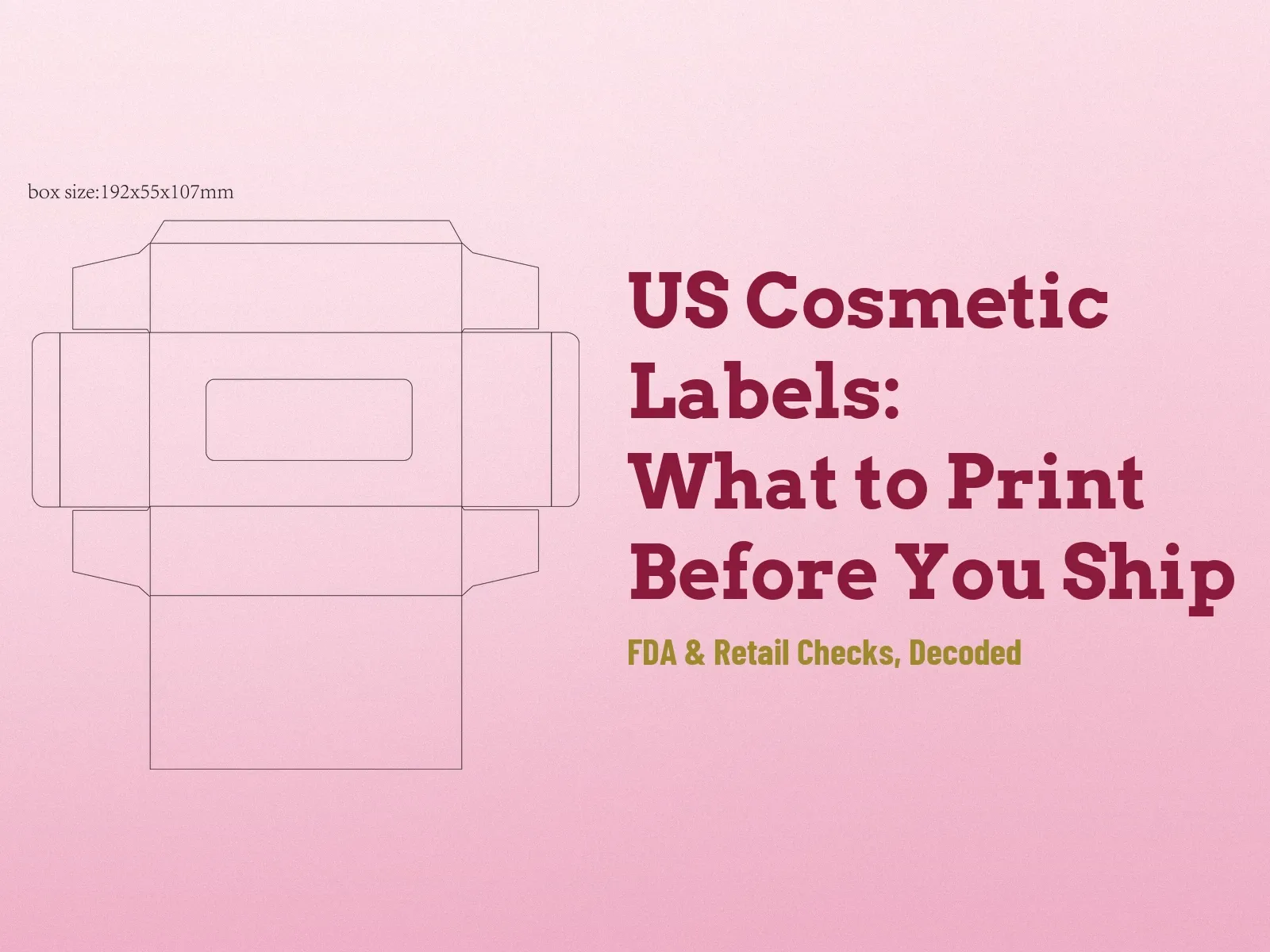
If you print only eight things, print these: (1) a statement of identity, (2) the net quantity in US units, (3) a full ingredient declaration, (4) the name and place of business of the company responsible, (5) a US contact for adverse-event reports, (6) any required warnings and directions, (7) “Made in China”, and (8) a scannable GS1 barcode. The first seven come from US law — the FD&C Act, the Fair Packaging and Labeling Act, FDA’s rules in 21 CFR Part 701 and Part 740, MoCRA, and the Tariff Act. The barcode comes from your buyers: no US law requires it, but US retail and marketplaces will not list a product without one. This article shows where each item goes, how big it must be, and which common “EU-style” label habits get products held up in the US.
What goes on the front panel, and what goes on the information panel?
US labels are built in two zones. The principal display panel (PDP) — the face a shopper sees on the shelf — carries only the identity and the net quantity. Everything else goes on an information panel, usually the back or side. Putting an item in the wrong zone is itself a compliance error.
The PDP is the part of the label “most likely to be displayed or examined” at retail (21 CFR 701.10). The statement of identity says what the product is — its common or usual name, a descriptive name, or a picture that makes its use clear: “Lip Gloss”, “Liquid Blush”, “Nail Polish”. A brand name and a shade name (“Rose Shine 04”) do not replace it. The net quantity sits in the bottom 30% of the PDP, parallel to the base the package stands on, separated from other print so it reads at a glance.
If your product is sold in an outer box, the required statements go on the box as well as on the tube or bottle inside — a compliant tube inside a blank carton is still a misbranded product at retail.
FRONT — PRINCIPAL DISPLAY PANEL
YOUR BRAND
Lip Gloss
Rose Shine · Shade 04
NET WT. 0.20 fl oz (6 mL)
Net quantity in the bottom 30% of the panel, US units first, metric beside it.
BACK — INFORMATION PANEL
Ingredients: Water, Glycerin, … Fragrance, FD&C Red No. 40 (CI 16035). May Contain: Titanium Dioxide (CI 77891), Iron Oxides (CI 77491).
Directions: Apply to lips as desired. Warning: For external use only. Discontinue use if irritation occurs.
Distributed by: [US Distributor Name], [Street], [City, ST ZIP], USA Questions / adverse events: [US phone] · [website] MADE IN CHINA · LOT: LG2607A
8 12345 67890 5
Illustrative UPC layout — not a scannable code.
How large must the net quantity be?
Minimum letter height is set by the area of the front panel (21 CFR 701.13). Measure your panel before artwork, not after printing:
Front panel area — Minimum net-quantity letter height — Typical product
5 sq in or less — 1/16 in (≈1.6 mm) — Lip gloss tube, lipstick carton
Over 5 – 25 sq in — 1/8 in (≈3.2 mm) — Blush compact box, gift set sleeve
Over 25 – 100 sq in — 3/16 in (≈4.8 mm) — Multi-piece display box
Ingredient declaration (separate rule): 1/16 in; 1/32 in only if the whole labelling surface is under 12 sq in — very small tubes may use a firmly attached tag, tape, card or leaflet instead.
How do you write the ingredients, the company name and the MoCRA contact?
List every ingredient by its INCI name in descending order of predominance, name the business responsible for the product with its place of business, and — since 29 December 2024 — add a US-reachable contact for adverse-event reports. An EU ingredient list pasted unchanged onto a US pack is the single most common error we see.
Ingredients — same formula, different names
Order: ingredients above 1% in descending order of predominance; ingredients at 1% or less may follow in any order; colour additives may be listed last regardless of amount (21 CFR 701.3).
Names: use the US form of the INCI name. Write “Water”, not “Aqua” on its own; “Fragrance”, not “Parfum”; and FDA colour names such as “FD&C Red No. 40” or “D&C Red No. 6”, with the CI number in brackets if you want it there. Fragrance and flavour may be declared simply as “Fragrance” / “Flavor” — the full fragrance formula does not go on the label.
Multi-shade ranges: colour cosmetics sold in several shades may list the range’s colour additives under “May Contain” (or “+/-”), so one carton can serve several shades.
Watch the drug line: claims such as “treats acne”, “SPF 30 sun protection”, “regrows hair” or “stops dandruff” turn the product into a drug in the US, with Drug Facts, expiry dating and a different registration route. Keep cosmetic claims to appearance — “adds shine”, “moisturising feel”, “long-wearing colour” — unless the product is genuinely registered as a drug.
Name, address and the MoCRA contact line
The information panel must state the name and place of business of the manufacturer, packer or distributor: street address, city, state and ZIP (the street may be omitted only if the firm is listed in a current city or telephone directory). If the named firm is not the maker, say so — “Manufactured for …” or “Distributed by …” (21 CFR 701.12).
MoCRA added a second duty that sits on the same panel: every cosmetic label must carry a domestic (US) address, a domestic phone number, or electronic contact information such as a website through which the responsible person can receive reports of adverse events. A Chinese factory address and a +86 phone number do not satisfy this — for a China-made product, this line normally belongs to the US importer or brand named on the label. Behind the label, that same responsible person must also have registered the manufacturing facility with FDA and listed each product (submitted through FDA’s Cosmetics Direct portal), and hold safety substantiation. None of that appears on the pack, but an importer will ask for it before the first order ships.
Still changing: FDA’s MoCRA rule on disclosing individual fragrance allergens on the label had not been finalised at the time of writing (checked November 2026). Do not copy the EU’s allergen list onto a US label and call it a US requirement — and do not promise a buyer an allergen format that is not yet law.
Barcode, “Made in China”, batch code and dates — what is law, and what is retail?
“Made in China” is law. The barcode is retail. A batch (lot) code is not spelled out in the federal cosmetic labelling rules, but it is how recalls and buyer quality checks work, so treat it as non-negotiable. An expiry date, a manufacturing date and the open-jar PAO symbol are not required on a US cosmetic — print them because your buyer’s specification asks for them, not because the FDA does.
Item — Status in the US — How to print it correctly
Barcode — RETAIL: Not required by FDA. Required by supermarkets, pharmacy chains, Amazon and most importers’ warehouses. How to print: License a GTIN from GS1 US and print it as a UPC-A (12 digits). One GTIN per shade and per size — four lip gloss shades = four GTINs. Standard printed size ≈ 1.46 × 1.02 in (37.3 × 25.9 mm), black bars on white, quiet zones kept clear, placed on the back, away from seams and curves. Never reuse a GTIN on a different product, and avoid reseller barcodes: many retailers verify the number against the GS1 database and reject numbers registered to someone else.
Made in China — LAW: Required by the Tariff Act of 1930, 19 U.S.C. §1304, enforced by US Customs — separate from FDA labelling. How to print: Print the English name of the country of origin — “Made in China” — in a conspicuous place, legibly, indelibly and permanently, so the ultimate US buyer can see it before purchase. Put it on the retail pack itself, not only on the shipping carton. Place it near the US distributor’s name and address, so the US address cannot be read as the place of manufacture.
Batch / lot code — PRACTICE: No federal cosmetic rule sets its format, but MoCRA recall duties make traceability a real obligation, and every serious buyer checks for it. How to print: Print one code per production run, identically on the tube crimp or base and on the outer carton, e.g. LOT LG2607A. Keep your internal record linking that code to the formula, the fill date and the shade. The lot code is not the barcode and not the shade number — buyers reject packs where the three are confused.
Manufacturing date — BUYER SPEC: Not required on US cosmetics. How to print: If your buyer asks for an open date, print it in plain form — MFG: 07/2026 — next to the lot code. A date hidden inside a coded batch number that only your factory can read does not meet a buyer’s “open production date” specification.
Expiry date & PAO — BUYER SPEC: FDA states there is no US requirement to print expiration dates on cosmetics. The exception is products regulated as drugs (sunscreen, anti-acne and similar), which follow drug labelling including expiry dating. Many marketplaces and chains still ask for an expiry date. How to print: If you print one, it must be a real date supported by your stability data, in a clear format (EXP: 06/2029). The EU open-jar “12M” symbol may also appear on a dual-market pack, but in the US it is information only — it replaces nothing.
One more check that sits outside the label but decides shipments: California Proposition 65 warnings, where a listed chemical is present above the warning level, and any state or retailer-specific list your importer works to. Ask the importer for their restricted-substance and labelling specification before artwork, not after printing.
Which mistakes actually get cosmetic shipments held, delisted or reworked?
Almost none of the failures below are about design. They are text errors — a missing contact line, an EU ingredient name, a net quantity in the wrong place — and all of them are cheaper to fix in the artwork file than on 5,000 printed tubes.
EU label shipped as-is: “Aqua / Parfum / CI-only” ingredient lists, ml-only net content, and an EU Responsible Person address where the US distributor and MoCRA contact should be.
Net quantity missing, metric-only, or in the middle of the front panel instead of the bottom 30%, or lettering smaller than the panel-size minimum.
No adverse-event contact, or a contact that is only a non-US address or phone number.
“Made in China” only on the master carton, in small low-contrast type, or placed far from the US address it could be confused with.
Drug claims on a cosmetic — SPF numbers, acne, whitening-as-treatment or hair-regrowth wording copied from another market’s artwork.
Barcode problems: one GTIN shared across shades, a reseller-bought number, bars printed in a colour, on a transparent film, or wrapped around the curve of a small tube so scanners fail; on small tubes, put the barcode on the outer carton.
Required text only on the tube, blank outer box — the box is what is displayed and scanned at retail, and it must carry the full labelling too.
Pre-print checklist — United States
Front panel: product identity (“Lip Gloss”) + shade, nothing else crowding the bottom 30%
Net quantity: US units first with metric beside it — 0.20 fl oz (6 mL) — letter height matches the panel-area table
Ingredients: US INCI names, descending order above 1%, colour additives last, “May Contain” for shade ranges
Name and place of business, with “Manufactured for / Distributed by” where it applies
MoCRA adverse-event contact: US address, US phone number, or website
Warnings and directions where the product needs them; no drug claims
“MADE IN CHINA” — conspicuous, legible, permanent, near the distributor block
GS1 UPC-A barcode, one GTIN per shade/size, tested with a real scanner at final print size
Lot code printed the same on tube and carton; MFG / EXP dates added if the buyer’s specification asks for them
Importer has confirmed: facility registration, product listing, and any Prop 65 / retailer specification
FAQ — US cosmetic labels
Does the FDA require a barcode on cosmetics?
No. There is no barcode requirement in FDA’s cosmetic labelling rules. The requirement comes from retail: supermarkets, pharmacy chains and marketplaces such as Amazon need a GS1 GTIN — printed as a UPC in the US — to list, scan and stock the product. Treat it as commercially mandatory and legally optional.
Does a US cosmetic label need an expiry date or a manufacturing date?
Not under federal law. FDA states plainly that no US law requires expiration dates on cosmetic labels, and there is no manufacturing-date or PAO requirement either. Products that are drugs as well as cosmetics — sunscreen is the common example — follow drug labelling and do carry expiry dates. Many US buyers still specify an EXP date contractually; if you print one, back it with stability data.
Can I sell in the US with my EU label?
Not safely. The ingredient names differ (Water vs Aqua, Fragrance vs Parfum, FDA colour names vs CI-only), the net quantity must be led by US units on the front panel, the pack must name the US business responsible and carry a US adverse-event contact instead of an EU Responsible Person, and “Made in China” marking follows US customs rules.
Where exactly does “Made in China” have to go?
On the product’s retail packaging, in a place the final buyer will see, in English, legibly, indelibly and as permanently as the article permits (19 U.S.C. §1304). Printing it only on the outer shipping carton does not meet the marking rule, and it should sit close to any US name and address on the pack so the origin is not obscured.
Who registers with the FDA — the Chinese factory or the US brand?
Both sides have a part. Under MoCRA, manufacturing facilities must be registered with FDA and each product listed by the “responsible person” — the manufacturer, packer or distributor whose name appears on the label. In a typical export order that is your US importer or brand customer, working with your factory’s registration details. Agree in writing who files what before production starts.
Next step. Send us your current label draft (PDF or AI file), the full ingredient list, your shade list and the US state or retailer you are selling into. We will mark up what has to change for the US before you print — it is much cheaper than reworking printed tubes. Continue reading: Article 2 — EU cosmetic label rules.